Frais de port offerts : dès 19€ en Locker Mondial Relay et 29€ en Colissimo (France Métropolitaine)
Frais de port offerts : dès 19€ en Locker Mondial Relay et 29€ en Colissimo (France Métropolitaine)

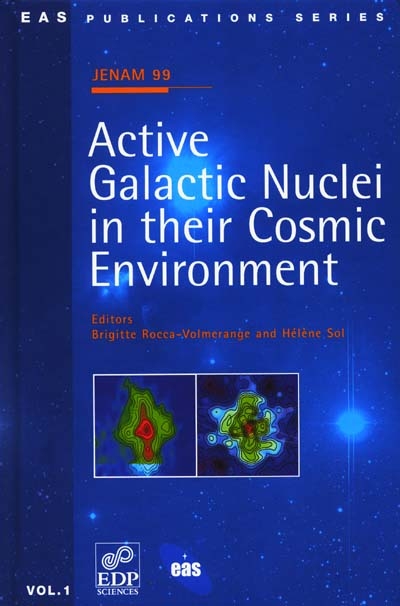
A profound challenge is now faced in extending the discovery of active galaxy nuclei at the highest redshifts in connection with the appearance of primeval galaxies. On the other side, the performances of the new generation of instruments and telescopes, specially for high spatial resolution images, open a new area focused on the most central engine of these active targets. In these respects, the primary scientific aim of this conference is to connect the different fields of fundamental physics and of observational technics, relating on the largest scales, the source and the cosmic environment.
Understanding the physics, formation and evolution of active galactic nuclei in close connection with the interstellar medium is a clear challenge for Astrophysics of coming decades. This book presents fascinating observations as well as recent results of theoretical or numerical modelling with special emphasis on multiwavelength approach, high angular resolution, high energy physics and accretion-ejection processes. Astrophysicists and physicists were assembled to invest far more intellectual effort to reap the benefits of the data obtained. The link with the universe at high redshift and evolution of galaxies remains present at any time.
Auteur : JOINT EUROPEAN AND NATIONAL ASTRONOMICAL MEETING (1999 ; Toulouse)
Date de parution : 01/12/2002
Éditeur : EDP sciences
Collection : EAS publication series
Classification : Astronomie

(France Métropolitaine)

07400 Le Teil (Ardèche)

Carte bancaire

06 70 63 29 00