Frais de port offerts : dès 19€ en Locker Mondial Relay et 29€ en Colissimo (France Métropolitaine)
Frais de port offerts : dès 19€ en Locker Mondial Relay et 29€ en Colissimo (France Métropolitaine)

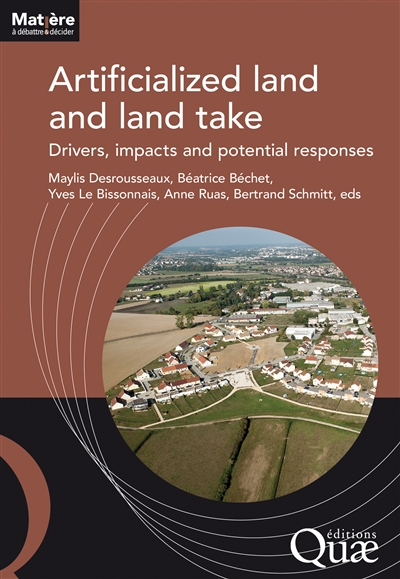
Soil artificialization is a recent concept, initially responding to the concern to quantify the loss of land available for agricultural use through changes in land use. Today, it refers to the overall reduction in the proportion of land devoted to agricultural and forestry activities or to natural areas, thus going beyond the strictly agricultural dimension.
Land artificialization and land that has already been 'artificialized', have become, particularly in France, a major issue of public debate and political concerns. Land artificialization is thus seen as one of the main factors in the erosion of biodiversity, which explains why, since 2015, the rate of land artificialization is one of the 10 « Wealth Indicators » developed by the Government to monitor its public policies.
In this context, the French Ministry of Ecology, the French Agency for Ecological Transition (ADEME) and the French Ministry of Agriculture, Agrifood, and Forestry wanted to have access to scientific knowledge that would enable them to better identify the economic and social determinants of soil artificialization, its impacts on the environment and on agriculture, and the levers for action likely to limit its development and negative effects. They entrusted IFSTTAR (now université Gustave Eiffel) and INRA (now INRAE) with the task of carrying out this collective scientific expertise. The main conclusions are presented in this book first published in French in 2019.
Date de parution : 01/02/2024
Éditeur : Quae
Collection : Matière à débattre et décider
Classification : Agriculture, élevage



(France Métropolitaine)

07400 Le Teil (Ardèche)

Carte bancaire

06 70 63 29 00